
CVD vs HPHT Lab Diamonds: Which Is Better? Pros, Cons & Differences
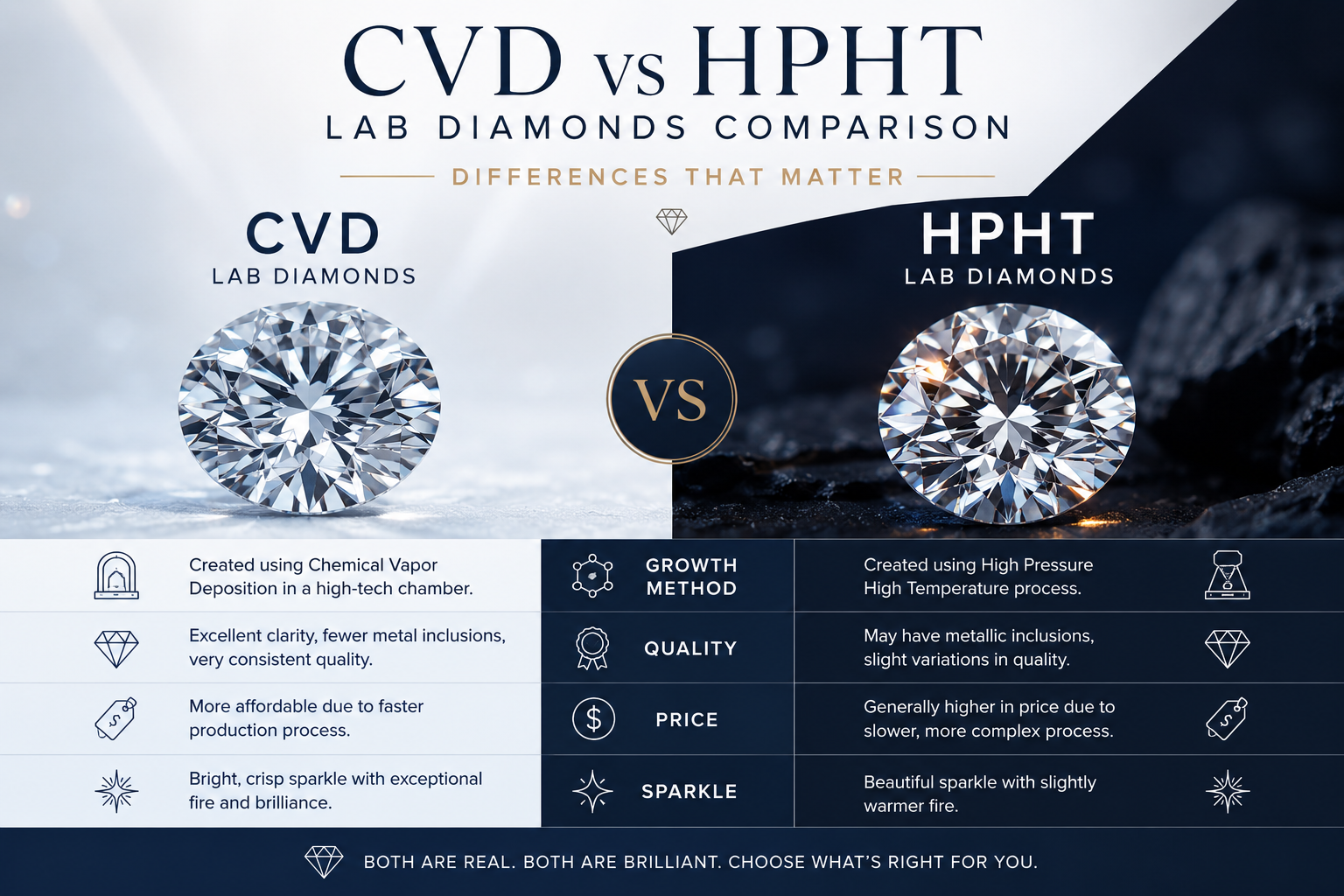
CVD vs HPHT Lab Diamonds: Which Is Better? Complete Guide
Lab-grown diamonds have transformed the jewelry industry by offering genuine diamonds at more affordable prices than mined stones. However, many buyers are confused about the two main manufacturing methods: CVD (Chemical Vapor Deposition) and HPHT (High Pressure High Temperature).
A common question is: CVD vs HPHT lab diamond—which is better?
The answer depends on what you value most, including price, quality, availability, and intended use. In this guide, we’ll compare both methods and help you choose the best lab-grown diamond for your engagement ring or fine jewelry purchase.
What Are Lab-Grown Diamonds?
Lab-grown diamonds are real diamonds created in controlled laboratory environments rather than mined from the earth.
They have:
✔ The same chemical composition as natural diamonds
✔ The same hardness (10 on the Mohs scale)
✔ The same brilliance and fire
✔ The same certification standards from IGI and GIA
The main difference lies in how they are grown.
What Is a CVD Diamond?
CVD (Chemical Vapor Deposition) diamonds are grown inside a vacuum chamber using carbon-rich gases.
How CVD Diamonds Are Created
- A thin diamond seed is placed in a chamber.
- Carbon-rich gases are heated into plasma.
- Carbon atoms bond to the seed.
- Layer by layer, a diamond crystal forms.
This process allows manufacturers to produce diamonds efficiently and at scale.
Advantages of CVD Diamonds
- Usually more affordable
- Widely available
- Excellent clarity potential
- Large diamond sizes available
- Popular for engagement rings
Disadvantages of CVD Diamonds
- May require post-growth treatment
- Occasionally show brownish undertones before treatment
- Growth process takes longer for larger stones
What Is an HPHT Diamond?
HPHT (High Pressure High Temperature) diamonds are created by replicating the extreme heat and pressure conditions found deep within the Earth.
How HPHT Diamonds Are Created
- A diamond seed is placed in a press.
- Carbon material surrounds the seed.
- Temperatures exceed 1,500°C.
- Pressure reaches over 5 GPa.
- The diamond crystal grows under these conditions.
Advantages of HPHT Diamonds
- Often excellent color quality
- Strong crystal structure
- Can produce exceptionally white diamonds
- Less likely to exhibit brown tint
Disadvantages of HPHT Diamonds
- Typically higher production costs
- Fewer large sizes available
- Some stones may contain metallic inclusions
CVD vs HPHT Lab Diamonds: Side-by-Side Comparison
| Feature | CVD Diamond | HPHT Diamond |
|---|---|---|
| Growth Method | Carbon gas deposition | High pressure and heat |
| Price | Usually lower | Usually higher |
| Availability | Very high | Moderate |
| Large Sizes | Easier to produce | Less common |
| Color Quality | Excellent after treatment | Naturally excellent |
| Clarity | Excellent | Excellent |
| Durability | Same as natural diamond | Same as natural diamond |
| Hardness | 10 Mohs | 10 Mohs |
| Sparkle | Identical | Identical |
Which Has Better Sparkle: CVD or HPHT?
Neither.
The sparkle of a diamond depends primarily on:
- Cut quality
- Proportions
- Symmetry
- Polish
A well-cut CVD diamond will outperform a poorly cut HPHT diamond and vice versa.
When comparing diamonds, focus on the cut grade rather than the growth method.
Which Is More Durable?
There is no meaningful difference in durability.
Both CVD and HPHT diamonds are:
- Real diamonds
- 10 on the Mohs hardness scale
- Suitable for everyday wear
- Ideal for engagement rings
Both can last a lifetime with proper care.
Which Is More Affordable?
In most cases, CVD diamonds are more affordable.
Because the CVD process is easier to scale, manufacturers can produce larger quantities at lower costs.
Typical savings range from:
- 5%–20% lower prices than comparable HPHT diamonds
- Significant savings on larger carat sizes
This makes CVD diamonds particularly attractive for budget-conscious buyers.
Which Has Better Color?
Historically, HPHT diamonds often displayed better color characteristics.
However, modern CVD technology has improved dramatically.
Today, both methods can produce:
- D Color
- E Color
- F Color
- Near-colorless grades
When certified by IGI or GIA, most consumers cannot visually distinguish between high-quality CVD and HPHT diamonds.
Are CVD Diamonds Better for Engagement Rings?
For most buyers, yes.
CVD diamonds offer:
- Better value
- Wider availability
- Excellent quality
- More size options
- Competitive pricing
This combination makes them one of the most popular choices for modern engagement rings.
Are HPHT Diamonds Better for Luxury Jewelry?
HPHT diamonds can be an excellent choice for buyers seeking premium color grades and specific characteristics.
Many luxury jewelers use HPHT diamonds for:
- High-end engagement rings
- Tennis bracelets
- Diamond stud earrings
- Fine diamond necklaces
However, the difference is often minimal when both diamonds are properly certified.
Expert Recommendation: Which Is Better?
Choose CVD Diamonds If You Want:
✔ Better value for money
✔ Larger carat sizes
✔ More selection
✔ Lower prices
✔ Excellent engagement ring options
Choose HPHT Diamonds If You Want:
✔ Premium color grades
✔ Traditional growth simulation
✔ Specific certified stones
✔ High-end collector preferences
Frequently Asked Questions
Are CVD diamonds real diamonds?
Yes. CVD diamonds are chemically, physically, and optically identical to mined diamonds.
Are HPHT diamonds better than CVD?
Not necessarily. Both can achieve exceptional quality. The best choice depends on budget and preferences.
Can jewelers tell the difference?
Most jewelers require specialized equipment to identify the growth method.
Which diamond holds value better?
Both have similar market value trends because they are lab-grown diamonds.
Do CVD diamonds sparkle less?
No. Sparkle depends on cut quality, not the growth process.
Final Verdict: CVD vs HPHT Lab Diamond—Which Is Better?
For most jewelry buyers in 2026, CVD diamonds offer the best combination of quality, affordability, and availability, making them an excellent choice for engagement rings and fine jewelry.
However, HPHT diamonds remain a premium option, particularly for buyers seeking top color performance and specific diamond characteristics.
Ultimately, the best lab-grown diamond is not determined by whether it is CVD or HPHT—it is determined by its cut, color, clarity, certification, and overall craftsmanship.

![Does Temu Ship to Serbia? [Temu Serbia Guide]](https://temufinds.com/wp-content/uploads/2024/08/Does-Temu-Ship-to-Serbia-768x432.jpg)
![Does Temu Refund Stolen Packages? Answered [2025]](https://temufinds.com/wp-content/uploads/2024/08/Does-Temu-Refund-Stolen-Packages-768x432.jpg)
![Does AliExpress Sell Junk? [2025]](https://temufinds.com/wp-content/uploads/2025/06/Does-AliExpress-Sell-Junk-768x432.jpg)
![Where Is The Activity Page On Temu? [2025]](https://temufinds.com/wp-content/uploads/2024/06/Where-Is-The-Activity-Page-On-Temu-768x432.jpg)
![How to Find Zara Dupes on Shein? [Guide 2025]](https://temufinds.com/wp-content/uploads/2024/08/How-to-Find-Zara-Dupes-on-Shein-768x432.jpg)
![Does Shein Do Tax Free Returns? Answered [2025]](https://temufinds.com/wp-content/uploads/2024/09/Does-Shein-do-Tax-Free-Return-768x432.jpg)